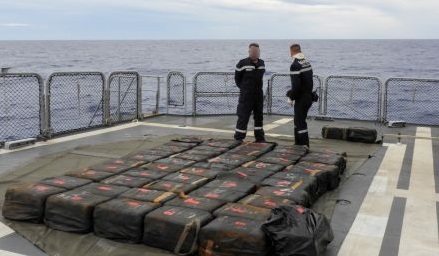


Joint Pacific operation results in 4.2 tonne cocaine intercept
05.45pm 05 February 2026
In a major blow against transnational, serious and organised crime, French authorities with assistance from New Zealand and US agencies have intercepted 4.24 tonnes of cocaine in French Polynesia this week.
On Monday 2 February 2026, a French Navy vessel, supported by a Falcon 50 aircraft, intercepted a suspicious ship on the high seas. The onboard inspection led to the discovery of 174 bales of cocaine, totalling 4.24 tonnes.
The vessel had been identified by French Customs in Polynesia as part of an investigation in collaboration with New Zealand Customs, the New Zealand Defence Force (NZDF) and the Government Communications Security Bureau (GCSB), which provided assistance with maritime intelligence to support the interception.
New Zealand Customs Deputy Chief Executive Operations, Jamie Bamford, has welcomed the significant intercept, highlighting the operation as one example of collaboration between like-minded agencies to disrupt large-scale smuggling.
“New Zealand Customs already works very closely with our partners to respond to cross-border crime in the Pacific. We welcome this significant seizure as another major blow against transnational, serious and organised crime,” Mr Bamford said.
Following Ministerial direction, Operation Kiwa has combined the capabilities of all three agencies to deliver enhanced intelligence operations and the use of Naval and Air Force capabilities to patrol the Pacific and defend New Zealand and our region.
Mr Bamford says New Zealand law enforcement agencies know we cannot do this in isolation, and so we work closely with international partners across the Pacific and the Americas, including with US and French authorities in French Polynesia.
“Working collaboratively with French authorities and the United States’ Drug Enforcement Agency, Operation Kiwa has supported our French partners to successfully seize 4.2 tonnes of cocaine from reaching our Pacific neighbourhood.
“Our message to criminals attempting to exploit maritime routes or international supply chains for drug smuggling is unequivocal: New Zealand’s strengthened regional response has increased the risk of detection and this is just the beginning.
“We will operate as an international network to track and stop you from causing more harm to our people and their livelihoods. You are not welcome here,” he adds.
Anyone with suspicions about possible maritime drug smuggling should contact Customs confidentially either via customs.govt.nz/report or 0800 WE PROTECT (0800 937 768) or call Crime Stoppers anonymously on 0800 555 111.